Nearly 3 in 10 people who traded in a car this year owed more on it than it was worth — $7,107 more, on average. And when they went to buy the next car, the dealer offered to make that gap disappear.
What the dealer means is that the gap follows you into your next loan, at 8.1% interest, for six years or more. This guide shows you how to find out whether you are upside down, what the gap actually costs, and the ways out that do not involve paying interest on a car you no longer own.
What does it mean to be upside down on a car loan?
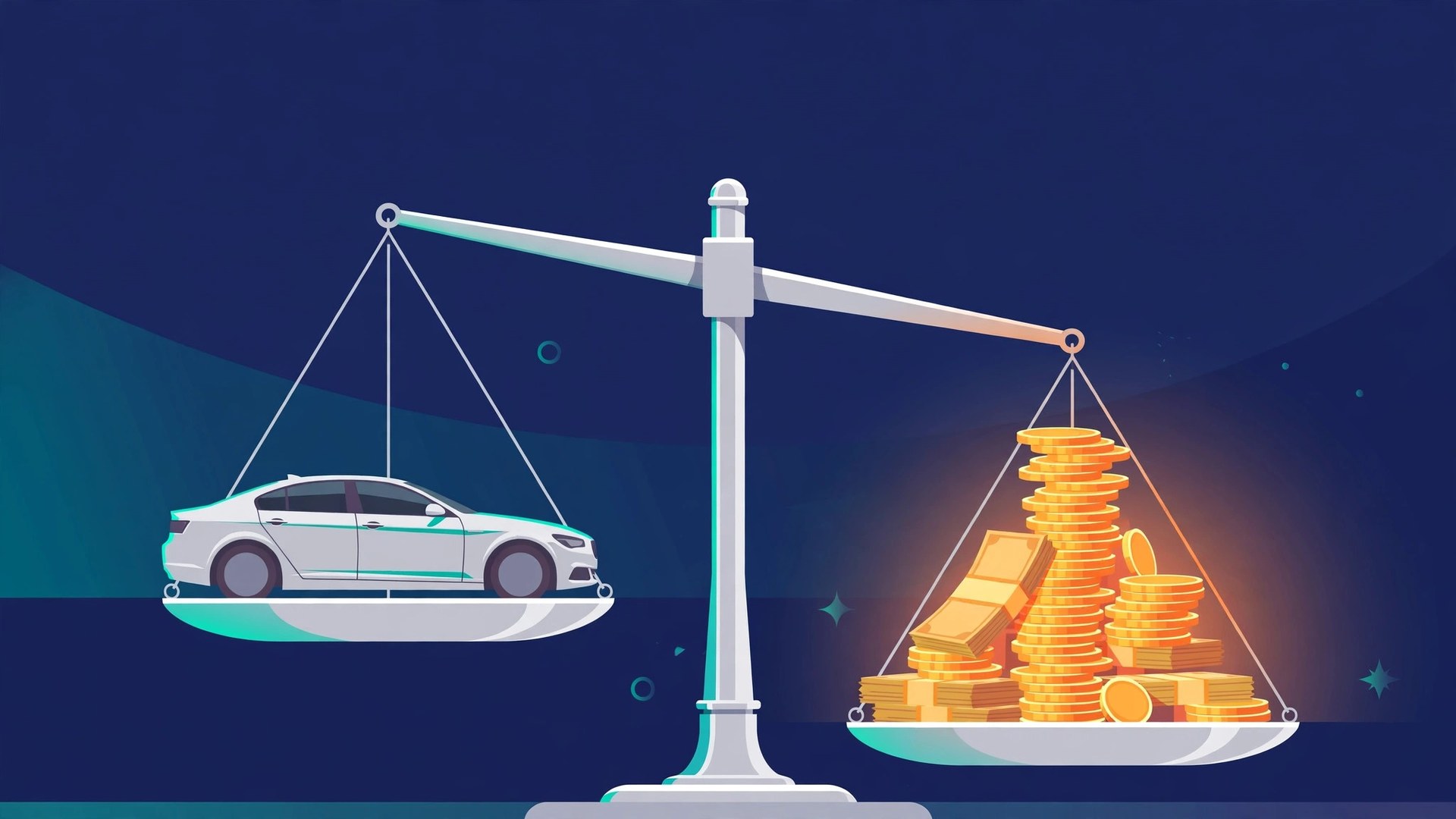
Being upside down — also called having negative equity — means your loan payoff is higher than your car's current value. If you owe $24,000 and the car is worth $18,500, you are $5,500 upside down. That $5,500 does not vanish when you sell or trade the car. Somebody pays it, and if you are not careful, that somebody is future you, with interest.
It happens to careful buyers, not just careless ones. Four forces push a loan underwater:
- Depreciation is front-loaded. A new car typically loses more than 10% of its value in the first month and about 20% in the first year, according to Carfax data cited by Experian (May 2026). Five years after purchase, the average new car is worth about 40% of its sale price.
- Small down payments. The average new-car down payment was only $5,554 in the third quarter of 2026, about 11% of the price, according to Edmunds. With a small down payment, the loan starts out larger than the car's value almost immediately.
- Long loan terms. The average new-car loan ran 70.5 months in the third quarter of 2026, and 25.5% of financed purchases stretched to 84 months or longer (Edmunds, October 1, 2026). A long loan pays down principal slowly while the car keeps losing value.
- Rolling old debt forward. When a buyer trades in an underwater car, the leftover balance gets added to the new loan — which starts the next car underwater on day one.
How common is negative equity right now?
Very common — and the amount owed is near a record. Edmunds' analysis of the third quarter of 2026 found the problem has eased slightly from the start of the year but is still worse than a year ago, and has risen year over year for four straight years:
| Measure | Q3 2026 | Comparison |
|---|---|---|
| Share of financed trade-ins underwater | 29.1% | 28.1% in Q3 2025; 30.9% at the start of 2026 |
| Average amount owed over the car's value | $7,107 | $5,000–$5,500 pre-pandemic (2016–2019); $6,884 in Q2 2026 |
| Average amount financed by rollover buyers | $57,235 | $39,732 in Q3 2019 (+44.1%) |
| Average monthly payment, rollover buyers | $952 | $646 in Q3 2019 |
| Average APR on rollover loans | 8.1% | 7.0% average for all new-car loans |
| Estimated interest over the loan's life | $16,610 | $9,093 in Q3 2019 (+83%) |
| Share of rollover loans at 72 months or longer | 91.2% | — |
Source: Edmunds, "America's Negative Equity Problem Is Fueling a New Cycle of Record Auto Loan Debt" (October 20, 2026); Edmunds Q3 2026 new-car financing data (October 1, 2026).
The average underwater trade-in now owes $7,107 more than the car is worth — the highest third-quarter figure in at least a decade, according to Edmunds (October 20, 2026). The share of underwater trade-ins has eased from its 30.9% peak at the start of 2026, but the amount each one owes keeps climbing.
The trend is not turning yet: J.D. Power forecast that 29.6% of trade-ins in October 2026 would carry negative equity. This is a market-wide problem, not a personal failure — but the cost of it lands on the individual buyer.
How do I check if my car loan is upside down?
Three numbers, ten minutes. Do this before you shop for a replacement, not after you have fallen for one.
- Get your payoff quote. Call your lender or check your account online and ask for a 10-day payoff — the exact amount that closes the loan today, including interest accrued so far. Your monthly statement balance is close, but the payoff quote is the number that counts.
- Look up what the car is worth. Get your car's KBB Private Party Value and its Edmunds True Market Value, using your year, trim, mileage and honest condition. Our private-sale pricing guide walks through both lookups and how to sanity-check them against local listings.
- Subtract. Payoff minus value is your equity — positive or negative. If the payoff is $24,000 and the value is $18,500, you are $5,500 upside down. Write the number down. It is the figure every decision below turns on.

If the number surprises you, check it twice: a payoff quote that includes a prepayment penalty (rare on auto loans, but ask) or a valuation that overstates your car's condition can each move it by hundreds of dollars. Neither changes the direction — only the size.
What does rolling negative equity into a new loan actually cost?
This is the part the "we'll pay off your trade" pitch never spells out. When a dealer rolls your old balance into a new loan, you are borrowing money to pay for a car you no longer own — and paying interest on it for years. Compare the average new-car buyer with the average buyer who rolled negative equity forward in the third quarter of 2026:
| Average new-car buyer | Buyer rolling over negative equity | |
|---|---|---|
| Amount financed | $44,664 | $57,235 |
| Monthly payment | $787 | $952 |
| APR | 7.0% | 8.1% |
| Estimated total interest | $9,938 | $16,610 |
| Difference | — | +$12,571 financed, +$165 a month, +$6,672 in interest |
Source: Edmunds Q3 2026 new-car financing data (October 1, 2026) and Edmunds Q3 2026 negative equity report (October 20, 2026).
That is the cost of convenience: $165 more every month, and nearly $6,700 more in interest, for the same new car. And because 91.2% of rollover buyers took terms of 72 months or longer, the higher payment runs for six years or more — long enough for the new car to go underwater too, and for the cycle to repeat at the next trade-in.
Before you sign a deal that rolls debt forward, run the numbers yourself in MyFavi's monthly payment vs. total cost calculator. Put the rolled-over amount in, try 60, 72 and 84 months, and look at the total interest line — not just the monthly payment.
Can I sell a car I still owe money on?
Yes. A loan does not stop you from selling — it just changes the order of operations. Your lender holds the title until the loan is paid off, so the sale proceeds go to the lender first, and the title is released once the payoff clears.
The practical steps:
- Get the payoff quote first, as above. You cannot close a sale without it.
- Price the car on its value, not on what you owe. Buyers do not care about your loan balance. Our private-sale pricing guide shows how to set an asking price from book values and local comps.
- If the sale price is less than the payoff, bring the difference in cash at closing. That is the cleanest way out of an underwater loan: the gap is settled once, with no interest attached.
- Confirm the payment has settled before the keys change hands. Never trust a payment screenshot, and verify any cashier's check with the issuing bank. Our scams guide walks through the payment tricks sellers actually face.
- Handle the title the right way for your state. In Virginia, the seller signs the title over and completes the price certification; our Virginia private-sale guide covers it step by step. In Maryland, use the title transfer checklist.
A private sale usually nets more than a trade-in, and when there is a gap to cover, every extra dollar of sale price is a dollar you do not have to bring in cash or roll into a new loan.
What are my options if I'm upside down?
There are four ways out. Only one of them is free, and only one of them makes the problem worse.
- Keep driving it and pay extra toward principal. This is the surest route. Every extra dollar goes straight to principal, which shortens the time you spend underwater and cuts the total interest. Even $50 extra a month moves the payoff date forward. If the car is reliable, this is usually the right answer.
- Refinance — but only if the math actually improves. A refinance helps if it lowers your rate or shortens your term. Many lenders will not refinance a loan that is larger than the car's value, and a longer term at a lower rate can still cost more overall. For context, borrowers who refinanced saved $83 a month on average in the second quarter of 2026, according to Experian. Before you apply, check what the new payment does to your budget in MyFavi's car affordability calculator.
- Sell privately and cover the gap with cash. If you have the savings, this ends the problem in one transaction: the loan closes, the interest clock stops, and your next car starts with a clean slate. It is the best option when the gap is small and the car is worth selling.
- Trade it in and roll the balance forward — the last resort. Only if the current car is unreliable or unsafe and you genuinely must replace it now. If you do, go in knowing the numbers: the average rollover buyer in the third quarter of 2026 financed $57,235 at 8.1% and paid $952 a month. Negotiate the new car's price separately from the trade-in, and never let a low monthly payment hide a longer term.
One more thing to check while you are underwater: gap insurance. If your car is totaled, standard insurance pays its market value, not your loan balance — and the gap between the two is still yours. Gap insurance covers that difference. Check whether you already have it through your lender or insurer before you buy another policy.
How do I avoid negative equity on my next car?
The next purchase is where you break the cycle. The rules are simple, and they all work the same way: keep the loan smaller than the car's value for as long as possible.
- Put 20% down. The 20/4/10 rule — 20% down, a loan of 4 years or less, total car costs under 10% of gross income — exists because a new car loses about 20% of its value in the first year. A 20% down payment means you start with equity instead of a gap.
- Keep the term short. A 48- or 60-month loan pays down principal fast enough to stay ahead of depreciation. An 84-month loan does the opposite, and it is how a $44,664 average loan turns into a $787 payment that still leaves buyers underwater.
- Buy below the average. The average new car cost $49,766 in October 2026 (KBB/Cox). Our guide to buying a new car below the $50,000 average shows how to set a monthly ceiling first and right-size the segment.
- Buy at the right time. Late November through January is historically the cheapest window to buy — our guide to the best time to buy a car in 2026 works through the timing with a worksheet.
- Run the calculators before you sign. The affordability calculator shows what a payment does to your take-home pay, and the payment vs. total cost calculator shows what the term does to your total interest. Both take a minute, and both are cheaper than discovering the gap at trade-in time.
Your Negative Equity Check — Worksheet
Fill in each line before you decide what to do with an underwater car:
- Lender and 10-day payoff quote: $______ (date: ______)
- KBB Private Party Value: $______
- Edmunds True Market Value: $______
- Your equity (value minus payoff): $______
- Months left on the loan: ______ · Current APR: % · Current payment: $
- Extra principal you can pay each month: $______
- If you sold privately: expected sale price $______ · cash needed to close the gap $______
- If you traded in and rolled it over: new amount financed $______ · new monthly payment $______ · new total interest $______
- Your decision: keep driving / refinance / sell privately / trade in (circle one) — and the date you will revisit it: ______
Before You Trade In or Sell an Upside-Down Car — Checklist
- 10-day payoff quote in hand, with the date it expires
- KBB and Edmunds values looked up and written down
- Equity calculated — payoff minus value — and written on the worksheet
- Extra principal payment worked out, if keeping the car
- Refinance quotes compared on rate AND term, not payment alone
- Private-sale price set from book values and comps, not from the loan balance
- Cash to cover the gap identified, if selling privately
- Rollover cost checked in the payment calculator — amount financed, payment, total interest
- Gap insurance checked — do you already have it?
- Payment confirmed settled before the keys change hands — never trust a payment screenshot
Sources: Edmunds, "America's Negative Equity Problem Is Fueling a New Cycle of Record Auto Loan Debt" (October 20, 2026); Edmunds, "New-Car Financing Records Pile Up in Q3" (October 1, 2026); Experian, "What Is Depreciation on a Car?" (May 12, 2026); J.D. Power October 2026 trade-in forecast, reported by The Epoch Times (October 29, 2026); KBB/Cox average transaction price, October 2026.
Written by MyFavi Team
MyFavi's car-buying guidance is independent — no dealer ties, no sponsored picks. We check every price and claim against its source before we publish.
Topics
- negative equity
- car loans
- financing
- trade-in
Share this article
The MyFavi newsletter
Save money on your next car
Get notified on deals, price drops, and buying hacks, once a week.