More than 450,000 vehicles are sold in the United States every year with false odometer readings. The cars look clean, the seller sounds reasonable, and the price is just good enough to hurry you. Then the transmission slips in week three, the tires are eight years old under full tread, and the title carries a brand nobody mentioned. None of that was invisible — it was just never checked.
A used-car inspection is the cheapest money in car buying. Thirty minutes of your own checks, plus a professional pre-purchase inspection that typically costs $100 to $250, can keep you from buying somebody else's problem. This guide works through both halves the way a buyer actually has to: the walkaround you do yourself in the seller's driveway, the paper checks that catch the expensive lies, and the mechanic's inspection that settles what your eyes cannot — with a worksheet at the end so you can run the whole check on the car in front of you before you pay.
What is a pre-purchase inspection — and what does it cost?
A pre-purchase inspection (PPI) is a paid check of a used car by an independent mechanic before you buy it. It is not the same as a state safety or emissions inspection: a state sticker only says the car met a minimum standard on the day it was tested. A PPI is a buyer's inspection, done for you, by a mechanic who has no relationship with the seller.
| Where you get it | Typical price | What you get |
|---|---|---|
| Independent repair shop | $100–$250 | Lift inspection, scan-tool code check, fluids, brakes, tires, road test, written report |
| Mobile inspection (standard car) | About $220–$250 | Inspector comes to the car; visual and road-test check, scan, photos, written report |
| Mobile inspection (classic, exotic, luxury) | About $286–$499 | Specialist checks cost more |
| Chain shop (Pep Boys 120-point) | $85 | 120-point check including OBD test codes and a test drive |
Sources: independent-shop and mobile prices from Help by Experts, updated November 12, 2026 (Consumer Reports puts a typical mechanic's fee at $100–$150; Capital One cites $100–$200); Pep Boys 120-point price from Top Consumer Reviews, November 2026. Prices vary by region and by car — confirm when you book. Checked November 15, 2026.
Two things matter more than the price. First, the mechanic must be yours, not the seller's — an inspection by the seller's own shop is a second opinion from the person selling you the car. Second, book it before you agree on a price. The report is negotiating leverage only while the money is still in your pocket.
The 30-minute DIY inspection: what to check yourself
You do not need to be a mechanic to catch most bad cars. You need daylight, a phone flashlight, a coin, and a willingness to walk away. Do this in daylight, on dry pavement, with the engine cold — a warm engine hides a hard start, and a wet car hides leaks and paint work.
Minutes 0–5: the walkaround
Walk slowly around the car twice. The first pass is for the story the car tells at a glance; the second is for the details.
- Panel gaps and paint. Gaps between panels should be even all the way around. A door gap that widens at the top, a hood that sits crooked, or paint that is a slightly different shade on one panel means bodywork — ask what happened, and check the history report against the answer.
- Rust. Check the wheel arches, the bottom of the doors, and the rocker panels under the doors. Surface rust on a ten-year-old car is normal; bubbling paint or soft metal is not. Fresh undercoating sprayed over the whole underside can be a seller hiding rust — if the undercarriage looks suspiciously new on an old car, ask why.
- Glass and lights. Chips and cracks in the windshield, fogged headlights, and any light that does not work are all negotiating points — and a cracked windshield is a replacement cost, not a cosmetic quibble.
- The ground under the car. Fresh drips on dry pavement are a leak. Oil is dark and slick; coolant is usually green, orange, or pink and smells sweet; transmission fluid is red or brown. Any of them means a repair quote before you offer.
Minutes 5–10: the tires — tread and age
Tires are the most honest part of a used car, and the most commonly skipped check. A set of four tires costs hundreds of dollars, and a seller who put cheap, old, or mismatched tires on a car has usually cut corners elsewhere too.
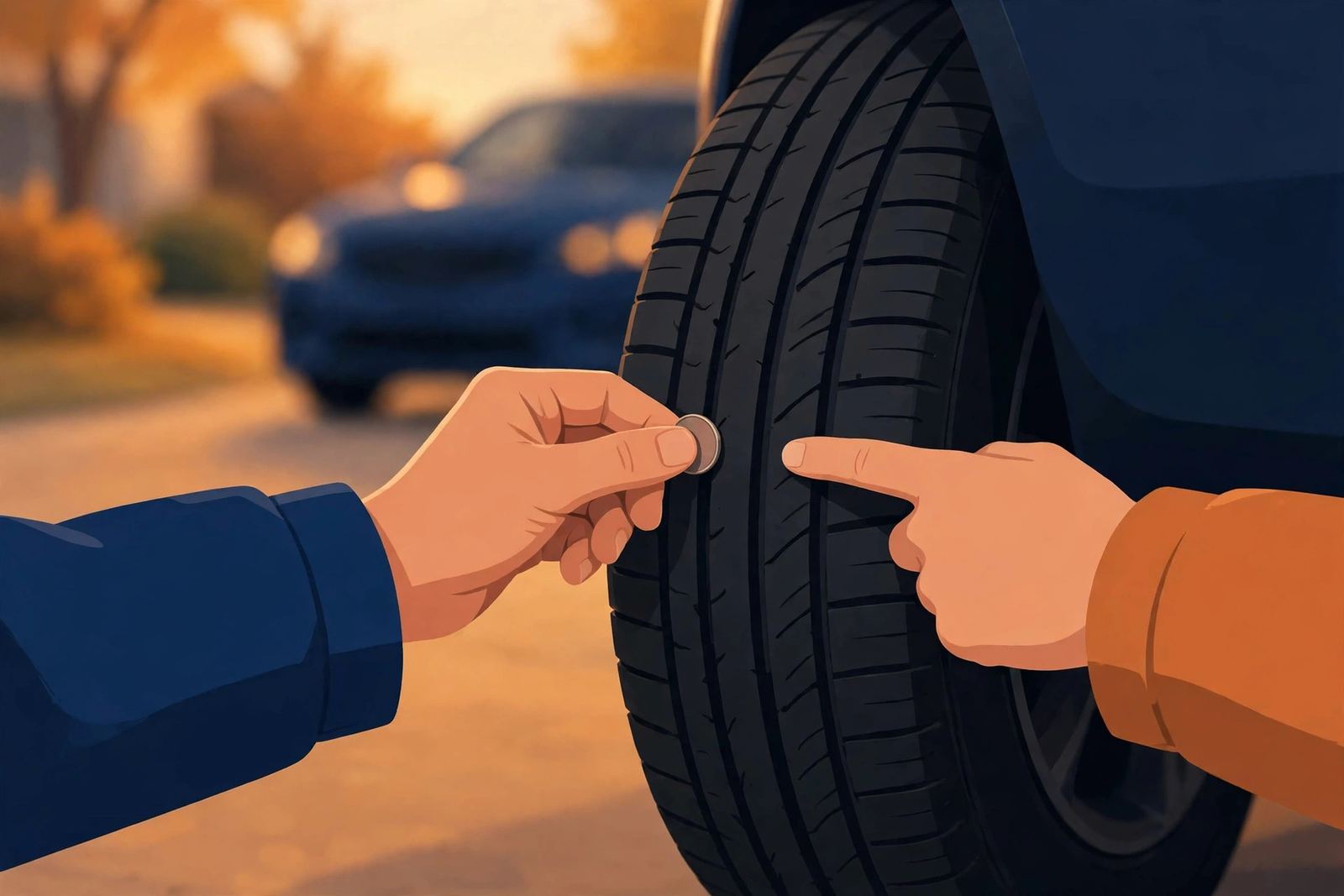
- Tread depth. Push a penny into a tread groove with Lincoln's head down. If you can see the top of his head, the tread is below 2/32 of an inch — the legal minimum in most states — and the tires are done. A quarter, Washington's head down, is the better test: if you can see the top of his head, you are at 4/32 and the tires are near the end of their useful life.
- Wear pattern. Even wear across the tread is normal. Wear on the inside or outside edge points to alignment or suspension problems. Wear in the centre means over-inflation; wear on both edges means under-inflation. A car with one bald tire and three good ones has a story.
- The date code. This is the check most buyers miss, and it matters more than the tread. Every tire carries a DOT code on its sidewall, and the last four digits are the week and year it was made: a code ending in 2319 means the 23rd week of 2019. NHTSA notes that some vehicle and tire manufacturers recommend replacing tires that are six to ten years old regardless of tread — rubber ages even when a car sits still, and Michelin and Bridgestone both put the outer limit at ten years. A tire with full tread that is nine years old is not a good tire; it is a tire that has never been used and has been ageing anyway. If any tire is over six years old, budget for replacement or get a tire shop's opinion before you buy.
Minutes 10–15: under the hood
Check the fluids with the engine cold. You are not diagnosing anything — you are looking for neglect.
- Engine oil. Pull the dipstick, wipe it, dip it again. The oil should be amber to dark brown and between the marks. Milky, frothy oil means coolant is mixing with it — walk away. Oil far below the mark means the engine is burning or leaking it.
- Coolant. The reservoir should be between the marks, and the coolant should be its normal colour — green, orange, or pink depending on the car. Rusty-brown coolant means the system has been neglected.
- Transmission fluid. On cars that still have a dipstick, it should be red or pinkish, not brown or black, and it should not smell burnt. Many newer cars have sealed transmissions with no dipstick — that is a check for the mechanic, not for you.
- Belts and hoses. Cracked, glazed, or frayed belts and soft, swollen hoses are wear items, but a car full of them is a car whose owner deferred maintenance.
- The battery. Corrosion around the terminals is cheap to clean but worth noting; a battery with a date sticker older than four or five years is near the end of its life.
Minutes 15–20: inside the car
Sit in every seat. Turn everything on. A seller who rushes you past the interior is hiding something in it.
- Every switch and button. Windows, locks, mirrors, wipers, heater, air conditioning, radio, and every dashboard light. Air conditioning that blows warm is a repair, not a recharge — a recharge that lasts a week means a leak.
- The smell. A heavy air freshener, damp carpet, or a musty smell can mean a water leak or a flood car. Pull up the trunk carpet and look at the spare-tire well for rust, silt, or a water line. About 530,000 flood-damaged cars were on the road as of August 2025 (CARFAX) — and a flood car that was never reported will not show up on a history report, which is why this check matters.
- The seats and pedals. Wear on the driver's seat bolster and the pedals should roughly match the mileage. A car showing 40,000 miles with a worn-through brake pedal and a shiny steering wheel has either lived a hard life or is not showing its real mileage.
- Warning lights. Turn the key to the run position without starting the engine: the check-engine, airbag, ABS, and oil lights should all come on, then go out once the engine is running. A light that never comes on at all may have been disabled to hide a fault — a missing bulb is a louder warning than a lit one.
Minutes 20–30: the test drive
Drive the car the way you will actually use it — not around the block. Ten minutes of mixed driving tells you more than an hour of looking.
- Cold start. The engine should start promptly and idle smoothly. Rough idling, smoke from the exhaust (blue means burning oil, white means coolant, black means too much fuel), or a grinding starter are all reasons to stop and ask questions.
- Acceleration and braking. Accelerate firmly from a stop and at highway speed. Hesitation, slipping, or a transmission that clunks between gears is a repair measured in thousands. Brake firmly from 40 mph: the car should stop straight, without pulling, grinding, or a pulsing pedal.
- Steering. On a straight, empty stretch, the car should track straight with the wheel centred. A pull to one side, a wheel that vibrates, or steering that feels loose all point to alignment, tire, or suspension work.
- Listen. Turn the radio off. Clunks over bumps mean suspension wear; a whine that rises with speed can mean a wheel bearing or a transmission problem; a squeal when you brake means the pads are worn. Any noise you cannot explain is a question for the mechanic, not a detail to forget about on the drive home.
The five paper checks that catch the expensive lies
The physical inspection catches the car's condition. These five checks catch the car's story — and the story is where the expensive lies live.
NHTSA estimates that more than 450,000 vehicles are sold each year with false odometer readings, costing buyers more than $1 billion a year. The chance of odometer fraud in a vehicle's first 11 years is 3.47%. The odometer is a number on a screen; the history report is the evidence behind it.
1. Match the VIN in three places. The 17-character vehicle identification number must be identical on the dashboard (driver's side, visible through the windshield), on the driver's door-jamb sticker, and on the title. A mismatch means stop — do not pay until the seller explains it in writing. Ask for the VIN before you travel to see the car, and run the checks below on that VIN before you leave home.
2. Run the history report — and read the mileage, not the summary. A CARFAX or AutoCheck report, or the federal NMVTIS database through vehiclehistory.gov, shows every mileage reading ever recorded: service visits, state inspections, insurance events, registration renewals. The highest recorded mileage is the minimum the car has actually done, whatever the dashboard says. Look for mileage that goes backwards between readings, long gaps with no readings, and a title brand — salvage, rebuilt, or flood — that the seller did not mention.
3. Check the title itself. Ask to see the original title, not a copy. The seller's name must match the titled owner; a title in someone else's name means the seller may be flipping the car without ever registering it — a curbstoner — and you would have no clean chain of ownership. Check for a lien: if a loan is still owed, the lienholder has to release it before the title is truly yours. Our Virginia private-sale guide, Maryland title-transfer checklist, and D.C. private-sale guide walk through the exact steps for each state.
4. Run the free recall check. Enter the VIN at nhtsa.gov/recalls — free, no signup. Two November 2026 recalls alone cover 1,356,604 vehicles: 720,796 BMWs (campaign 26V733000, water-pump fire risk — park outside until repaired) and 635,808 Honda Pilots and Acura MDX/TLX models (campaign 26V721, free power-steering reprogram). A recall is not automatically a reason to walk away — the fix is free at a franchised dealer — but it is a condition to get in writing before you pay, not a surprise after.
5. Ask for service records. A stack of receipts is the best evidence a car was maintained; a shrug is evidence too. Oil-change intervals, a timing-belt replacement on schedule, and receipts from a real shop all count. No records does not automatically kill a deal, but it means the mechanic's inspection has to work harder — and the price should reflect the uncertainty.
When to pay a mechanic — and what to ask for
Do your 30 minutes first. If the car passes your checks and the paper checks, spend the $100 to $250 on the professional inspection. That order matters: your walkaround filters out the obvious bad cars for free, so you only pay a mechanic for cars you would actually buy.
Tell the mechanic you are buying the car, not servicing it, and ask for the report in writing with photos. A good PPI covers:
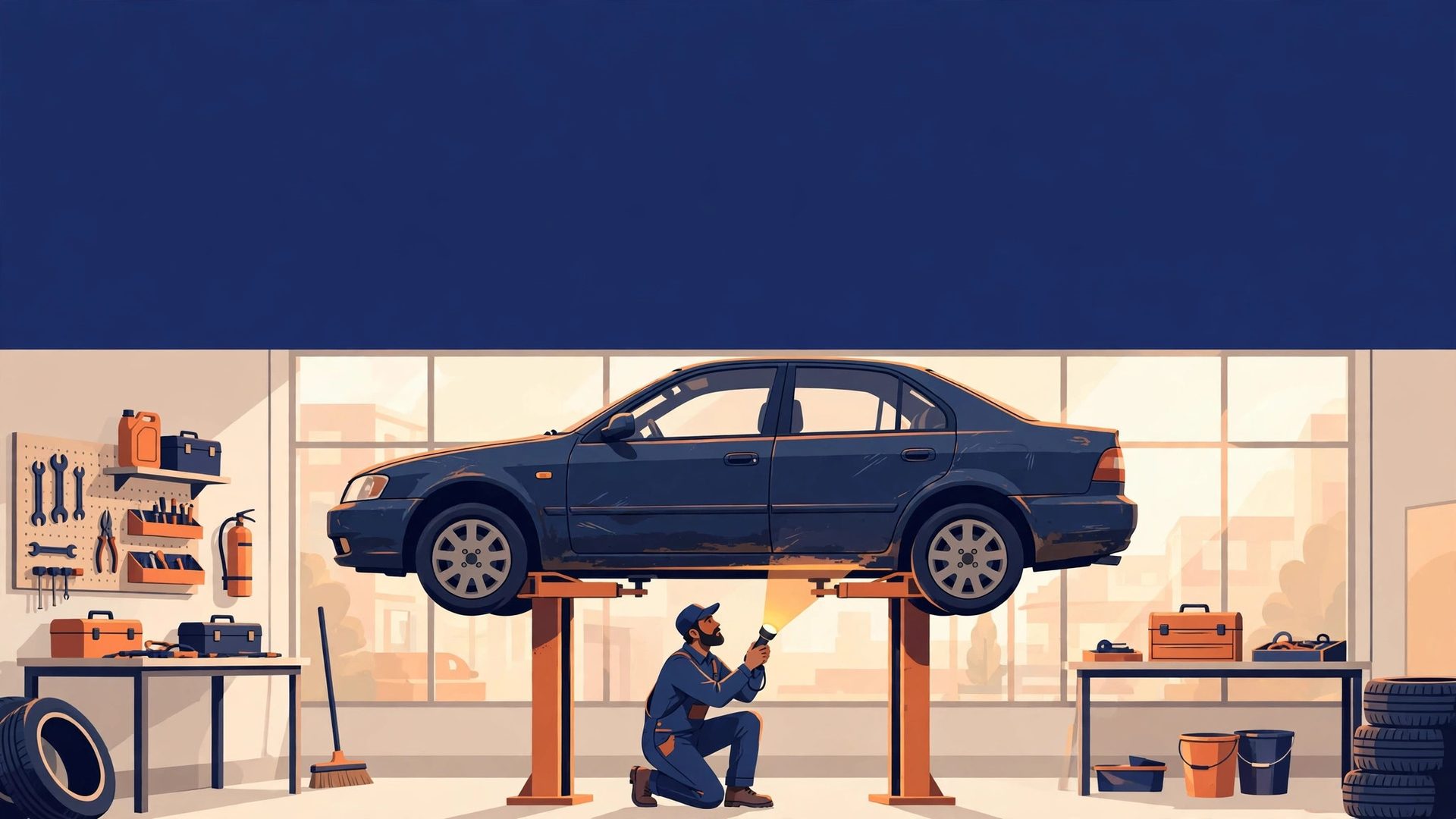
- Under the car, on a lift. Frame and unibody damage, rust on structural parts, leaking seals and gaskets, exhaust condition, suspension bushings, and brake lines — none of which you can see from the driveway.
- A scan-tool check. Stored and pending trouble codes, including codes the seller may have cleared the day before you arrived. A cleared code often comes back within a few drive cycles, so ask the mechanic whether the readiness monitors show a recent reset.
- Fluids and leaks under pressure. A mechanic can spot a head-gasket leak, a weeping rear main seal, or a transmission that is slipping under load — the failures that cost thousands and hide from a driveway check.
- Brakes and tires measured, not eyeballed. Pad thickness in millimetres, rotor condition, and tire age from the date codes, not just the tread.
- The test drive, by someone who does this for a living. A mechanic hears a failing wheel bearing or a slipping transmission in seconds, and can tell you whether it is a $200 fix or a $2,000 one.
For an electric car, add a battery-health report to the list — the battery is the car, and a degraded one is not a bargain at any price. Our EV guide covers what to ask for and how the remaining battery warranty (at least 8 years or 100,000 miles under federal rules) should factor into the price. For a car you are buying from a distance, a mobile inspection is the fallback — and for a remote private purchase, the inspection is non-negotiable: no PPI, no deal.
What a PPI can't tell you
An inspection is the best money you will spend on a used car, but it is not a guarantee, and a good mechanic will tell you so.
- Intermittent faults. A sensor that fails once a week, or a warning light that appears only on cold mornings, may not show up during a two-hour inspection.
- The future. A PPI tells you the car's condition today, not what will fail next year. A car with 120,000 miles will need wear items — brakes, suspension, a battery — and the inspection can tell you how soon, not whether.
- Hidden flood or frame damage. A well-repaired car can pass a visual inspection. That is why the history report, the title brand, and the flood checks in the trunk matter alongside the mechanic's report.
- Title and ownership problems. A mechanic checks the car, not the paperwork. The title, lien, and VIN-match checks are yours.
None of that makes the inspection optional. It makes it one leg of a three-legged check: your walkaround, the paper trail, and the mechanic. A car that passes all three is a car you can buy with confidence. A car that fails any one of them is a car you should price accordingly — or walk away from.
Red flags: walk away now
Some findings are negotiating points. These are not. If you hit one, thank the seller and leave.
- The seller refuses a pre-purchase inspection, or will only allow their own mechanic.
- The VIN does not match in all three places, or the title is not in the seller's name.
- The title is salvage, rebuilt, or flood-branded and the seller did not disclose it.
- Milky oil, white exhaust smoke, or coolant in the oil — a head-gasket failure.
- The odometer reading is lower than the highest reading on the history report.
- The seller pressures you to pay today, in cash, before any inspection — or shows you a payment screenshot as proof of anything. A screenshot is not payment, and a rushed buyer is a careless buyer.
- The car has no plates, no registration, and no insurance, and the seller wants you to drive it away anyway.
How to use the inspection to negotiate
An inspection that finds problems is not a failed inspection — it is a successful one. It just changed the price.
- Get the repair in writing. Ask the mechanic for a written estimate for everything found. A $900 brake job and a $600 set of tires are not opinions; they are numbers you can put in front of the seller.
- Price the car, then subtract the repairs. Our private-sale pricing guide shows how to price from 5–10 real local comps instead of the asking price. The inspection report tells you what to subtract from that comp-based price — and the seller's asking price is not the starting point.
- Offer fix-first, not discount-first, on safety items. If the brakes are worn or a tire is ten years old, ask the seller to fix it before the sale, at a shop you both agree on, with the receipt in your hand. A discount you never spend on the repair is a safety problem you now own.
- Get the total in writing. Whatever you agree, the full out-the-door price — price, taxes, title, and fees — goes in writing before you sign. Our out-the-door price guide breaks down the fee stack line by line, including Maryland's $800 doc-fee cap, so you can spot a fee that was not in the deal.
- Check the payment math before you sign. Run the numbers through the affordability calculator and the payment vs. total cost calculator — a car that needs $1,500 of immediate repairs is a car that costs $1,500 more than its price.
Pro tip: Amazon Autos lists cars with a fully itemized cost breakdown, and you can check the price breakdown and even buy online — a useful second quote to hold against a private seller's or a dealer's price. Through November 30, 2026, eligible Prime members who buy or lease a new car on Amazon Autos get a $1,500 Amazon.com gift card (Amazon, November 9, 2026). Check the current terms on Amazon before counting on it — and if the car you are replacing still has a loan on it, read our negative equity guide before rolling the shortfall into a new loan.
Timing still matters too: late November through January is historically the cheapest window to buy, and our guide to the best time to buy a car in 2026 works through the timing with a worksheet. And if the price still stretches your budget, set a monthly ceiling first — our guide to buying a new car below the $50,000 average shows how.
The 30-Minute Used-Car Inspection Worksheet
A printable fill-in worksheet: the 6-step inspection, the test drive, the paper checks, the PPI, and your offer - plus the before-you-pay checklist.
Free download. No account required.
Do not pay until you have walked around the car, read the paper, and — on any car you would actually buy — had your own mechanic look at it. The $100 to $250 inspection is the cheapest part of buying a used car; the repair you find after paying is the most expensive.
Sources
- NHTSA, Odometer Fraud: more than 450,000 vehicles are sold each year with false odometer readings, costing buyers more than $1 billion annually; 3.47% chance of odometer fraud in a vehicle's first 11 years. Checked November 15, 2026.
- Help by Experts, Pre-Purchase Car Inspection: Cost & What to Expect (updated November 12, 2026): PPI typically $100–$250 at an independent shop; about $220–$250 for a standard mobile inspection; about $286–$499 for classic, exotic, luxury, or commercial vehicles; Consumer Reports puts a typical mechanic's fee at $100–$150; Capital One cites $100–$200. Checked November 15, 2026.
- Top Consumer Reviews, 2026 Vehicle Inspection Service Reviews (November 2026): Pep Boys 120-point pre-purchase inspection $85; POMCAR basic inspection $180–$195. Checked November 15, 2026.
- Phoenix Mobile Mechanic Co., Pre Purchase Inspection in Chandler, AZ (updated November 7, 2026): a pre-purchase inspection typically takes 45 to 120 minutes and costs $100–$200. Checked November 15, 2026.
- NHTSA, TireWise and Tire Aging: some vehicle and tire manufacturers recommend replacing tires that are six to ten years old, regardless of treadwear; the DOT date code's last four digits are the week and year of manufacture. Michelin and Bridgestone guidance puts the outer limit at ten years from manufacture. Checked November 15, 2026.
- CARFAX (August 2025): about 530,000 flood-damaged cars on the road in the United States.
- NHTSA recalls, November 2026: campaign 26V733000, 720,796 BMWs (2012–2018, water-pump connector fire risk, park outside, no remedy yet); campaign 26V721, 635,808 Honda Pilots and Acura MDX/TLX models (power-steering software, free reprogram). Combined 1,356,604 vehicles.
- Amazon, Black Friday Week and Cyber Monday 2026 (November 9, 2026): from November 12 through November 30, 2026, eligible Prime members who buy or lease a new car on Amazon Autos get a $1,500 Amazon.com gift card. Checked November 15, 2026.
- MyFavi: the interactive inspection checklist tool walks through the PPI essentials step by step; the private-sale pricing guide prices from real comps; the out-the-door price guide breaks down the fee stack; the EV guide covers battery-health checks for used EVs.
Save money on your next car — get notified on deals, price drops, and buying hacks, once a week.
Written by MyFavi Team
MyFavi's car-buying guidance is independent — no dealer ties, no sponsored picks. We check every price and claim against its source before we publish.
Topics
- used-car-inspection
- pre-purchase-inspection
- ppi
- used-cars
- car-buying
Share this article
The MyFavi newsletter
Save money on your next car
Get notified on deals, price drops, and buying hacks, once a week.