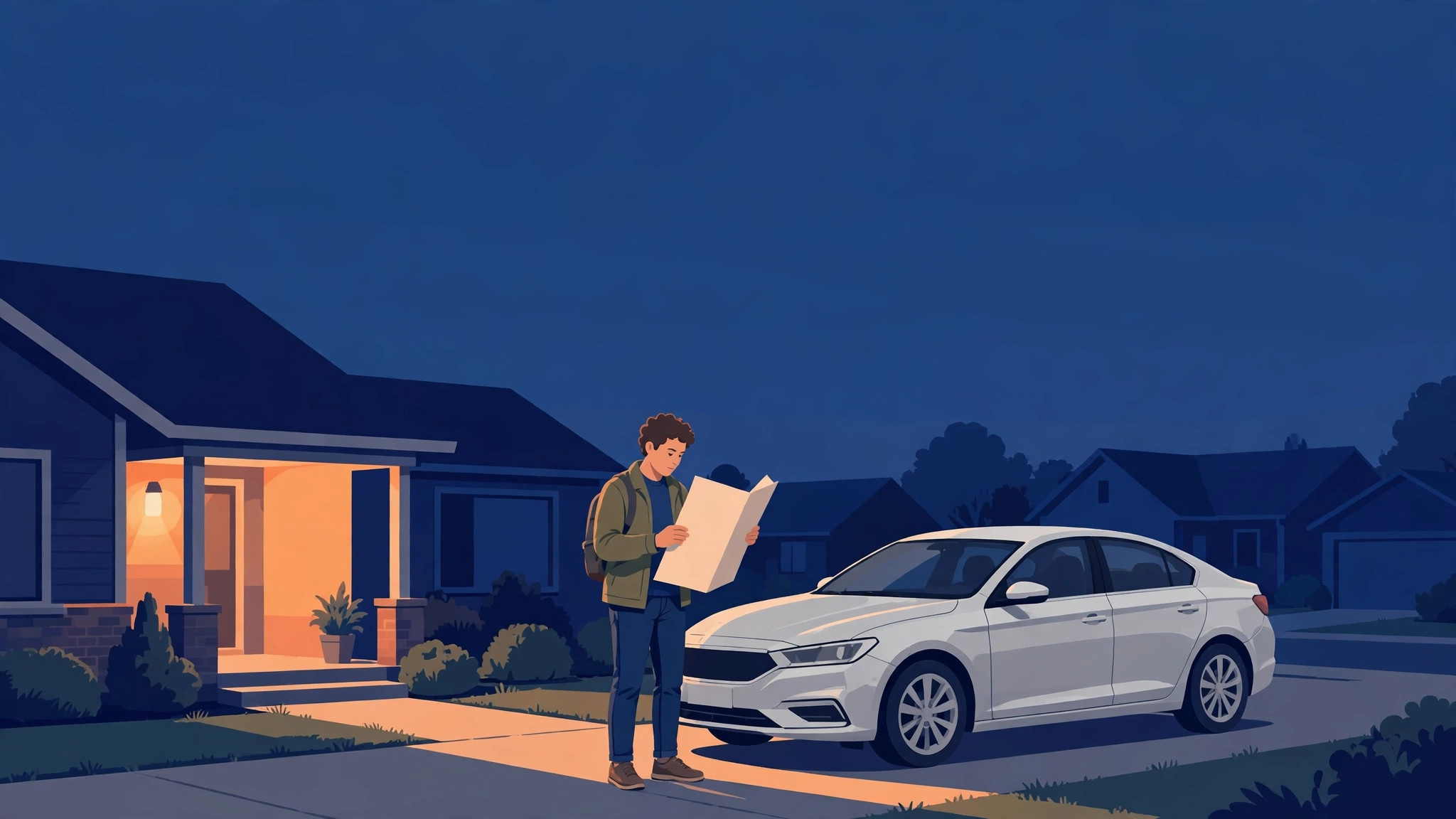
About 530,000 flood-damaged cars were on U.S. roads as of August 2025 — and a flooded car can be dried out, detailed, and resold with a title that looks clean. That is the whole problem with buying privately: the paperwork is the only proof the seller can legally sell you the car, and the paperwork is exactly what a dishonest seller knows how to make look right.
This guide teaches you to read that paperwork before money moves. Not after the test drive, not after the handshake — before you pay. The title tells you who owns the car, whether a lender still has a claim on it, whether an insurer once wrote it off, and whether the mileage on the dash is the mileage the state has on record. Two minutes with the original title, plus three free checks, decides the only question that matters in a private sale: pay, renegotiate, pause — or walk away.
About 530,000 flood-damaged cars were on U.S. roads as of August 2025 (CARFAX) — and a flooded car can be dried out and resold with a title that looks clean. The title check happens before you pay, not after.
What does a car title actually prove?
A title is the state's record of who owns a car. In a private sale it does three jobs at once: it proves the seller is the owner, it shows whether anyone else has a claim on the car, and it carries the car's permanent history in the form of brands. A dealer handles titling for you. A private seller does not — the title passes from their hands to yours, and if anything on it is wrong, the problem becomes yours at the DMV.
The two-minute read has six checks. Do them in the seller's driveway, with the original title in your hands — never a photocopy, never a photo on a phone, never "the title is in the mail."
- The original title, not a copy. A photocopy proves nothing: it can be an old copy from before a lien was added, or a copy of a title that was later replaced. Ask for the paper original. If the seller cannot produce it, pause — a duplicate title costs about $30 in D.C. and takes 7–10 business days, and the seller should get one before you pay.
- The VIN matches in three places. Dashboard, door jamb, and title — all 17 characters, identical. A mismatch is a stop, not a question: do not pay, and do not let the seller explain it away in the driveway.
- The owner name matches the seller's photo ID. The name printed on the title must be the person standing in front of you. If it is not, you are looking at title jumping — covered below — and the sale cannot close cleanly.
- The brand box. This is the small box that says clean — or salvage, rebuilt, flood, junk, or lemon-law buyback. Read it word for word. Brands are permanent, and the table below explains each one.
- The lienholder box. If a lender is listed, someone still has a financial claim on the car. You cannot receive a clear title until that debt is paid and the lender files a lien release — get the release in writing before you pay, not after.
- The odometer disclosure and the paper itself. The mileage written on the title should match the dashboard. And the paper must be clean: no correction fluid, no cross-outs, no altered numbers. A DMV will not accept an altered title, and an altered title is a reason to walk away, not to negotiate.
Our 30-minute inspection guide covers the same six checks as part of its five paper checks, with the walkaround and the pre-purchase inspection around them. This guide goes deeper on the paper itself — what each brand means, and what to do when the name does not match.
Clean, lien, salvage, rebuilt, flood — what each brand means
Brands are official notations a state stamps onto a vehicle's title record. The wording varies by state, but the meanings below hold everywhere. Read the brand box, find the row, and the row tells you the move.
| Brand on the title | What it means | Your move |
|---|---|---|
| Clean / clear | No brand, no lienholder listed. The title reads as an ordinary car. | Proceed — but run the free checks below, because a clean-looking title is not proof (see title washing). |
| Lien | A lender still holds a financial interest — the seller still owes money on the car. | Pause. Do not pay until the lender's release is in your hands in writing. A missing lien release is the single most common reason a D.C. private sale stalls at the DMV. |
| Salvage | An insurer declared the car a total loss — repair costs exceeded a set percentage of its value — and the state branded it. | The car cannot legally be driven until it is repaired and passes a state inspection. If you are not buying a project car on purpose, walk away. |
| Rebuilt / reconstructed | A former salvage car that was repaired and passed the state's inspection. Legal to drive again. | A legitimate buy only at a real discount, with an insurance quote in hand first — its value is permanently impaired, and some insurers and lenders treat it differently. |
| Flood | The car sat in water deep enough to fill the engine compartment (the FTC's definition). Usually a total loss that was branded. | Walk away unless you are buying it as a parts car with your eyes open. Flood damage corrodes wiring and safety systems for months after the car looks dry. |
| Junk / non-repairable | The car was declared unfit to return to the road, ever. | Do not buy it to drive. It cannot legally be rebuilt for road use. |
| Lemon-law buyback | The manufacturer bought the car back under a state lemon law, usually after repeated failed repairs. | Treat it like a rebuilt title: legal to drive, value impaired, and worth a discount — and read exactly what defect forced the buyback. |
| Odometer brands — "not actual mileage" / "exceeds mechanical limits" | The state is telling you the mileage on the title cannot be trusted, or the odometer rolled past its mechanical limit. | See the odometer section below. Do not pay the asking price for a car whose mileage is officially uncertain. |
Sources: FTC consumer guidance on flood-damaged cars and title brands; NICB VINCheck brand definitions; NMVTIS brand guidance via vehiclehistory.gov. Brand wording varies by state — the definitions above are the standard meanings. Checked November 17, 2026.
Two notes on the table. First, a rebuilt title is not a scam by itself — it is a car that was written off, fixed, and inspected back onto the road. The problem is price: a rebuilt car is worth materially less than the same car with a clean title, and buyers who pay clean-title money for a rebuilt car lose that difference the day they resell. Second, some states do not have a flood brand at all, and others brand a flood car as salvage or rebuilt instead — so the absence of the word "flood" on a title proves nothing on its own.
The Before-You-Pay Title Checklist
A printable checklist for reading a car title before you pay: the 2-minute title read, the free VIN checks, the name-match decision, and the flood and odometer signs — for private buyers in the $8,000–$20,000 band.
Free download. No account required.
The checklist runs the six title checks, the three free VIN checks, the name-match decision, and the flood and odometer signs in order — so you can work through them in the seller's driveway before money moves.
Title jumping: when the seller's name isn't on the title
Title jumping is the most common name problem in a private sale, and the easiest to miss if you are in a hurry. The seller bought the car, never registered it in their own name, and is now selling it on the previous owner's title — sometimes with the assignment section left blank, sometimes signed over to someone else entirely. The seller skipped the tax, the title fee, and the paper trail. You would be buying from a person who, on paper, never owned the car.
That missing paper trail is the point. A seller who never registered the car has no clean chain of ownership to pass to you, and your state's DMV can refuse to title it in your name. It is also the signature of a curbstoner — an unlicensed dealer posing as a private seller to dodge licensing rules and lemon-law obligations. Maryland's MVA warns buyers about curbstoners explicitly, and our used-car buying checklist carries the same warning: do not buy from a private seller who does not hold the title in their own name.
The pattern is not theoretical. In February 2026, Miami-Dade sheriff's deputies arrested a dealership finance manager on 79 charges tied to about $1.5 million in fraudulent auto loans, run through brokers and straw buyers who signed prefilled loan documents and walked out with the keys (Local10 via NICB, February 26, 2026; Frank on Fraud, February 27, 2026). The mechanism was different — dealer fraud, not a driveway sale — but the tell is the same one this guide teaches: when the person in front of you is not the person on the paper, stop and ask why.
Three red flags together should end the deal on the spot: a very recent last title date, a seller who is not the titled owner, and a story that needs an explanation — "I'm selling it for my brother," "the title is in my wife's name and she's at work," "I just bought it and haven't gotten around to the DMV." Any one of those can have an innocent explanation. All three at once is a pattern.
What to do when the name doesn't match
Not every name mismatch is a scam, and the right response is a pause, not always a walkout. Work it in this order:
- Ask for the titled owner's signed assignment and the seller's photo ID. If the seller is selling for a spouse or a family member, the titled owner must sign the assignment themselves — the seller cannot sign someone else's name for them. Both owners must sign if two owners are on the title.
- Ask for a duplicate or corrected title and a lien release in writing. If the title is lost, damaged, or has the wrong name, the titled owner gets the duplicate — about $30 and 7–10 business days in D.C. — and you wait for it. A seller who will not wait is telling you something.
- Never pay on a photocopy, an altered title, or a promise. Correction fluid, cross-outs, or a white-out over the mileage or the name means the DMV will not accept the title. "The title is in the mail" means the seller does not have the one document that proves they can sell you the car.
- Walk away if the seller cannot produce either. No assignment from the titled owner and no corrected title means there is no clean chain of ownership, and no discount is worth a car you cannot register. The next car with a clean title is cheaper than the lawyer and the DMV fight this one needs.
If you are the seller, the same list is your pre-listing prep: original title in your name, lien release in hand, no alterations, both owners signing. A serious buyer will check all of it — be ready before you list, not after the buyer finds the problem. Our Virginia, Maryland, and D.C. seller guides walk through each state's transfer steps.
The free checks that catch what the title hides
The title is one data point. Three free checks — plus one cheap one — cover what the paper cannot: theft, total-loss history, recalls, and the title's history across state lines. Run them in this order, before you pay.
| Check | Cost | What it catches | What it misses |
|---|---|---|---|
| NICB VINCheck (nicb.org/vincheck) | Free — 5 searches per IP address per day | Whether the VIN was reported as an unrecovered theft, or as a salvage or flood total loss, by participating insurers | Anything not reported to a participating insurer — it does not query law-enforcement theft databases, and it shows no title brands, accidents, odometer readings, or recalls |
| NHTSA recalls (nhtsa.gov/recalls) | Free, no signup | Open safety recalls on the VIN | Everything else — it is a recall check only |
| NMVTIS report (vehiclehistory.gov) | Small fee, through a Department of Justice-approved provider | Title and brand history across states, the latest odometer reading, and total-loss and salvage-yard records | Liens and financing, owner names, repair history, and damage that was never reported as a total loss |
| CARFAX / AutoCheck history report | Paid | Mileage across titles, inspections, and service visits; accidents; brands the seller did not mention | Damage repaired out of pocket and never reported — read the mileage timeline, not just the summary |
Sources: NICB VINCheck (nicb.org/vincheck, checked November 17, 2026) — participating insurers represent 92.49% of U.S. earned insurance premium; NMVTIS consumer guidance via vehiclehistory.gov (checked November 17, 2026); NHTSA recalls at nhtsa.gov/recalls. NMVTIS was created under the federal Anti-Car Theft Act of 1992 and is operated by AAMVA under Department of Justice oversight.
Read the limits column as carefully as the catches column. NICB's own warning is blunt: a clean VINCheck result "does not guarantee that the vehicle you are searching for has a clean history." An uninsured flooded car will not appear in it — the FTC makes the same point about its flood database — and a theft reported only to the police will not appear either. NMVTIS is the government ledger of a car's legal identity, not a mechanical biography: it shows brands and odometer readings, not accidents or repairs, and it does not list liens — the lien is on the title itself, which is why the title read comes first. A paid history report fills the mileage gaps, but only if you read the mileage timeline: a reading that drops at any point is the single clearest evidence of a rollback.
Title washing: why a clean-looking title is not proof
Title washing is the reason a clean title cannot be the whole check. A branded car is moved to a state that treats the brand differently — or that has no flood brand at all — retitled there, and the new document prints cleaner than the old one. The brand is gone from the paper, but the damage is still in the car. The Department of Justice notes that a car treated as salvage in one state may not carry that brand in another, and the FTC warns that storm-damaged cars are routinely cleaned up and taken out of state for sale.
The timing is the reason this matters right now. On November 2–3, 2026, historic rain flooded St. Lucie and Brevard counties on Florida's Treasure Coast — the National Weather Service called it a 100-to-200-year event, with 16.7 inches of rain in Port St. Lucie — and police and tow companies spent the following days hauling disabled and abandoned cars off the roads to a temporary storage site at the MIDFLORIDA Event Center (TCPalm, November 3, 2026; inspect-first.com, November 10, 2026). Flooded cars can be dried out and resold with no flood brand, and used cars move across county and state lines — a Treasure Coast car dried out and sold privately could show up in a listing anywhere in the country weeks or months from now. That is the same window you are shopping in.
Warning signs that a clean-looking title may have been washed:
- Gaps in the title history, or a car that moved through several states in a short period — the pattern the Texas DMV links to washing a flood or rebuilt brand.
- A recent out-of-state title on a car being sold far from that state, especially a car from a storm area at an unusually low price.
- A total-loss entry in a history report that is absent from the title. If NICB or a CARFAX report shows a total loss and the title shows nothing, the brand was washed — or never applied.
- A car that was flooded but never insured. No claim was ever filed, no insurer ever wrote it off, and no brand was ever applied. That car is invisible to every database, which is why the physical check still matters.
The FTC's physical signs of a flood car are worth knowing before you meet the seller: mud, silt, or sand under the seats, under the carpet, or under the dashboard; rust around the doors and on unpainted screws and brackets; loose, stained, or mismatched carpet and upholstery; a musty or moldy odor — or the opposite tell, an overpowering cleaner or air freshener smell; fogging or moisture inside the headlights and taillights. No single sign proves a flood, but several together should end the deal. A pre-purchase inspection by an independent mechanic — typically $100–$250 — is the check that finds the water evidence a clean report hides.
The odometer line on the title
The title carries its own mileage check, and it is the one most buyers skip: the odometer disclosure, and the brand box's mileage notations. Two brands matter. "Not actual mileage" means the state knows the reading cannot be trusted. "Exceeds mechanical limits" means the odometer rolled past what it can display. Either one means the mileage on the dash is officially uncertain — price the car on that basis, or walk away.
The scale of the problem is why the line matters. CARFAX data from December 2025 puts about 2.45 million vehicles on U.S. roads with suspected rolled-back odometers — up 14% in a year — and buyers who unknowingly purchase one lose about $3,300 in value on average, before the repair bills that follow a car with far more miles than the dashboard claims. NHTSA's longer-running estimate is more than 450,000 vehicles a year, costing buyers more than $1 billion annually. The title's mileage reading, the history report's mileage timeline, and the dashboard should all agree; a reading that drops anywhere in the timeline is the clearest evidence of a rollback.
The law is on the buyer's side here, and it is unusually specific. Tampering with an odometer is a federal crime under 49 U.S.C. § 32703, punishable by up to three years in prison. A buyer who was defrauded can sue under 49 U.S.C. § 32710 for three times the actual damages or $10,000, whichever is greater, plus attorney's fees — but the claim must be filed within two years of discovering the fraud, so a buyer who finds the problem late can lose the remedy. That two-year clock is one more reason to check the mileage before you pay, not after you discover it.
The $8,000–$20,000 stakes: why this band can't absorb a title surprise
This guide is written for the buyer in the $8,000–$20,000 daily-driver band — the price range where MyFavi's private-sale pricing guide prices from real comps, and where most first-time private-market buyers shop. At this price the car is usually the buyer's daily driver and the whole budget. There is no cushion: a branded or liened car can mean no registration, a repossession risk, or a resale value hit that wipes out the "deal" entirely. A $3,300 odometer loss on a $12,000 car is more than a quarter of what you paid.
The market gives no cushion either. The Manheim Used Vehicle Value Index stood at 206.8 in October 2026, up 0.5% month over month and 2% year over year (Cox Automotive, November 6, 2026) — values are firm, not falling, so a buyer who overpays for a branded or liened car has little market movement to recover the loss. Cheap cars are the scarcest part of the market, which is exactly why the pressure to skip a check and pay fast is highest in this band.
So the decision order is fixed, and it is made in the driveway before money moves:
- Pay — title is original, VIN matches in three places, name matches the seller's ID, brand box is clean, no lienholder, mileage agrees, and the free checks come back clean.
- Renegotiate — a rebuilt or lemon-law brand, or an odometer brand, with the discount priced in and an insurance quote in hand. Use the affordability calculator to check whether the renegotiated payment still fits before you commit.
- Pause — a lien without a release in hand, a name that does not match, or a history report that needs an NMVTIS check to resolve. Pause means no money moves until the paper is fixed.
- Walk away — a salvage, flood, or junk brand on a car sold as a clean daily driver; an altered title; a seller who cannot produce the original; or a total-loss entry in a report that the title hides. The next car with a clean title is cheaper than this one with a bad one.
After the title checks out: the DMV steps
A clean title read is the pre-payment check. The transfer itself is a separate, state-specific job, and MyFavi already covers it for the DMV area — link to the right guide rather than repeating it here:
- Virginia: the buyer must submit the title and registration within 30 days; sales and use tax is 4.15% of the sale price, $75 minimum; the title fee is $15. See how to sell a car privately in Virginia.
- Maryland: excise tax is 6.5% of book value, the title fee is $200, and all title documents, tax, and fees are due within 30 days of delivery. See the Maryland title-transfer checklist.
- Washington, D.C.: a duplicate title is $30 and generally takes 7–10 business days; lien recordation is $20 per lien; a buyer temporary registration runs up to 45 days for $15. See how to sell a car privately in D.C..
Rules, fees, and brand wording vary by state — verify the details with the titling state before you sign, and check the transfer costs against the out-the-door price guide so a fee that was not in the deal stands out. The pricing guide prices the car from real comps before you get to the title at all — price first, then read the title, then pay, in that order.
Sources
- CARFAX, August 2025: about 530,000 flood-damaged cars on U.S. roads. Cited via MyFavi's 30-minute inspection guide. Checked November 17, 2026.
- CARFAX odometer rollback data, December 16, 2025: about 2.45 million vehicles suspected of rolled-back odometers, up 14% year over year; average loss about $3,300 in value. Checked November 17, 2026.
- NHTSA odometer fraud estimates: more than 450,000 vehicles a year, costing buyers more than $1 billion annually. Cited via MyFavi's inspection guide. Checked November 17, 2026.
- 49 U.S.C. § 32703 (odometer tampering prohibited), § 32709 (penalties — up to three years in prison), § 32710 (buyer's civil action — three times actual damages or $10,000, whichever is greater, plus attorney's fees, within two years). Checked November 17, 2026.
- NICB VINCheck, nicb.org/vincheck: free, five searches per IP address per 24-hour period; checks unrecovered theft and salvage or flood total-loss records from participating insurers, representing 92.49% of U.S. earned insurance premium; does not query law-enforcement records or non-participating insurers; not a comprehensive vehicle history report. Checked November 17, 2026.
- NMVTIS consumer guidance via vehiclehistory.gov: title and brand history, latest odometer reading, and total-loss and salvage-yard records from state agencies, insurers, and salvage yards; does not contain owner names, lien holder addresses, or repair history. Created under the Anti-Car Theft Act of 1992; operated by AAMVA under Department of Justice oversight. Checked November 17, 2026.
- FTC consumer guidance on flood-damaged cars: flood title means the car sat in water deep enough to fill the engine compartment; salvage title means an insurer declared the car a total loss; storm-damaged cars are sometimes cleaned up and taken out of state for sale; the NICB flood database covers insured cars only. Physical signs: mud, silt, or sand under seats, carpet, or dashboard; rust on doors and unpainted screws; loose, stained, or mismatched carpet; musty odor or strong cleaner smell; fogged headlights and taillights. Checked November 17, 2026.
- TCPalm, November 3, 2026, and inspect-first.com, November 10, 2026: historic rain flooded St. Lucie and Brevard counties November 2–3, 2026; National Weather Service called it a 100-to-200-year event, with 16.7 inches in Port St. Lucie; Port St. Lucie police and tow companies hauled disabled and abandoned cars to the MIDFLORIDA Event Center. Checked November 17, 2026.
- Local10 via NICB, February 26, 2026, and Frank on Fraud, February 27, 2026: Miami-Dade finance manager arrested on 79 charges tied to about $1.5 million in fraudulent auto loans, run through brokers and straw buyers signing prefilled loan documents. Checked November 17, 2026.
- Cox Automotive, November 6, 2026: Manheim Used Vehicle Value Index 206.8 in October 2026, up 0.5% month over month and 2.0% year over year. Checked November 17, 2026.
- MyFavi: the 30-minute inspection guide covers the walkaround and the five paper checks; the private-sale pricing guide prices from real comps in the $8,000–$20,000 band; the out-the-door price guide breaks down the fee stack; the Virginia guide, Maryland checklist, and D.C. guide cover the state transfer steps; the affordability calculator checks the payment against your budget.
Save money on your next car — get notified on deals, price drops, and buying hacks, once a week.
Written by MyFavi Team
MyFavi's car-buying guidance is independent — no dealer ties, no sponsored picks. We check every price and claim against its source before we publish.
Topics
- car-title
- private-car-sale
- title-brands
- vin-check
- car-buying
Share this article
The MyFavi newsletter
Save money on your next car
Get notified on deals, price drops, and buying hacks, once a week.